Why You Can See Everything's costumes are marketing studios can't buy
A three-hour Elizabeth Holmes documentary is set to lead a sluggish Halloween weekend, and we think the reason isn't genre: memes and costumes are marketing no studio can buy.
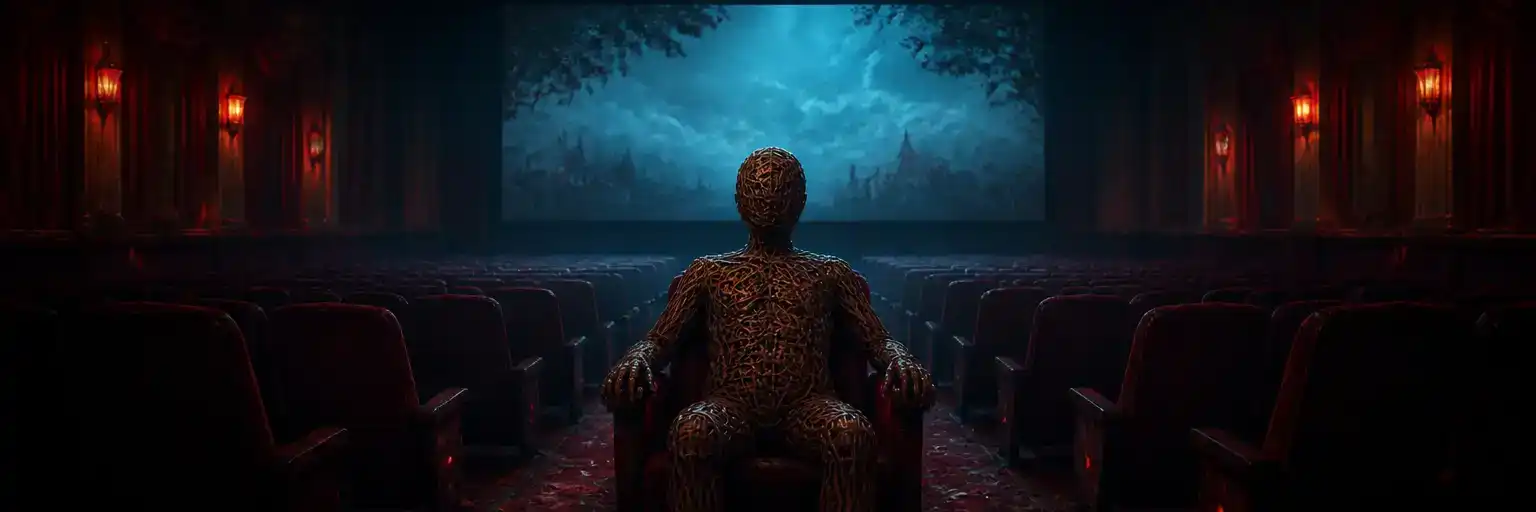
AI-generated image
Which carries more weight at the box office in 2026: a franchise with a giant marketing budget, or a documentary whose audience is turning up in costume? This weekend, the question is an uncomfortable one for studios. A three-hour documentary about Elizabeth Holmes is the one people are dressing up as.
Here is what we know. Deadline reports that A24's You Can See Everything, co-directed by Lance Oppenheim and Nathan Fielder, is destined to lead a sluggish Halloween frame with around $10M+, according to its sources. That would be a drop of roughly 40% from a second weekend of $19.5M, and the film's U.S. cume is at $52M+ and rising. Deadline credits non-stop social memes and the fact that Holmes and Fielder are the "it" Halloween costumes.
The costume is the new trailer
Look at what the film's audience is doing. Business Insider described a lookalike contest in which fandom "spilled onto the streets." Miami Moviegoers held its own, complete with imitation blood vials. A TV morning host has reportedly gone as Holmes again. As far as we can tell, none of this is paid media. It is people performing their membership in a conversation.
That matters because a costume is a ticket stub you wear. It tells friends, "I've seen it, I get the joke." And it makes everyone who hasn't seen it feel a small, productive pang of exclusion. Superhero franchises arguably used to own that dynamic. Now a documentary does, and we think that says as much about the franchises as about the documentary.
It's not the genre, it's the argument
The easy takeaway is "documentaries are back." We don't buy it. This looks less like a trend in nonfiction than like one film with an unusually shareable engine. Reviewers don't agree on what they saw. The Daily Illini calls it "a perfect film of meta proportion," while Ars Technica found it "surprisingly shallow" and says the only mystery is why a convicted fraudster is still deemed worthy of our attention. Decider argues that Fielder tricked viewers into believing he caught feelings, and admits it has no proof of that. A film that makes you want to text a friend "wait, was that real?" is a film with built-in word of mouth.
Fielder's brand of ambiguity is the product. Does the unblinking staring contest mean sincerity or performance? Is the final hour memory or staging? Those are not questions you resolve in the lobby. You carry them to brunch, to a group chat, to a costume party. Cultural currency, in other words, is just unfinished business that people enjoy trading.
There's also a subtler point. Holmes is already famous, and her story has been covered by an HBO documentary and a Hulu miniseries, as Ars Technica notes. The audience arrived pre-sold on the subject and, we suspect, hungry for a new angle. That is a very different thing from a documentary hoping to find a topic people care about.
What studios should (and shouldn't) learn
The lazy lesson is "engineer memes." You can't. Memes that studios manufacture feel manufactured, and the audience can smell it. What studios can do is leave room: make something with a face, a gesture, a line, an unresolved question, and then get out of the way.
The caution runs the other way too. A weekend lead in a slow frame is a relative win. We would not read a likely $10M+ as proof that costumes beat tentpoles on a normal weekend. This is a quiet holiday, and the film's own second-weekend number is bigger than what it's expected to make now. Fads decay, and Halloween looks like a hard deadline for this one.
Our verdict: the film's lesson is not "make documentaries," it's "make something worth arguing about, with a look people can copy." If you're deciding whether to see it, the three-hour runtime is the only real obstacle, and the conversation around it is half the experience. Go before the costumes go back in the closet.
No topics yet: start the first one.
More stories
Blaming Warner's old film chiefs for a reported $800M is the easy move
Page Six's framing blames the old film chiefs for 2026 losses, but bombs are bought years ahead, and the real test is whether the new owners can build a slate that looks different.

The Cat in the Hat can't fix Warner's box office alone
Warner is betting a beloved Dr. Seuss feline can rescue a rough 2026. Animation is a safe harbor, but it doesn't answer what kind of studio Warner Bros. wants to be.

Sorkin's "I have no visual sensibility" is the most honest line of the box office year
Aaron Sorkin's frank admission about his directing after The Social Reckoning bombed is rare and admirable, and it says more about Hollywood's habits than about him.
Wicker shows a weird R-rated fantasy can be sold by fans, not just studios
A $10 million folk-horror romance is adding more than 800 screens after fans begged for 4DX. Studios should stop polishing trailers and start listening to the internet.