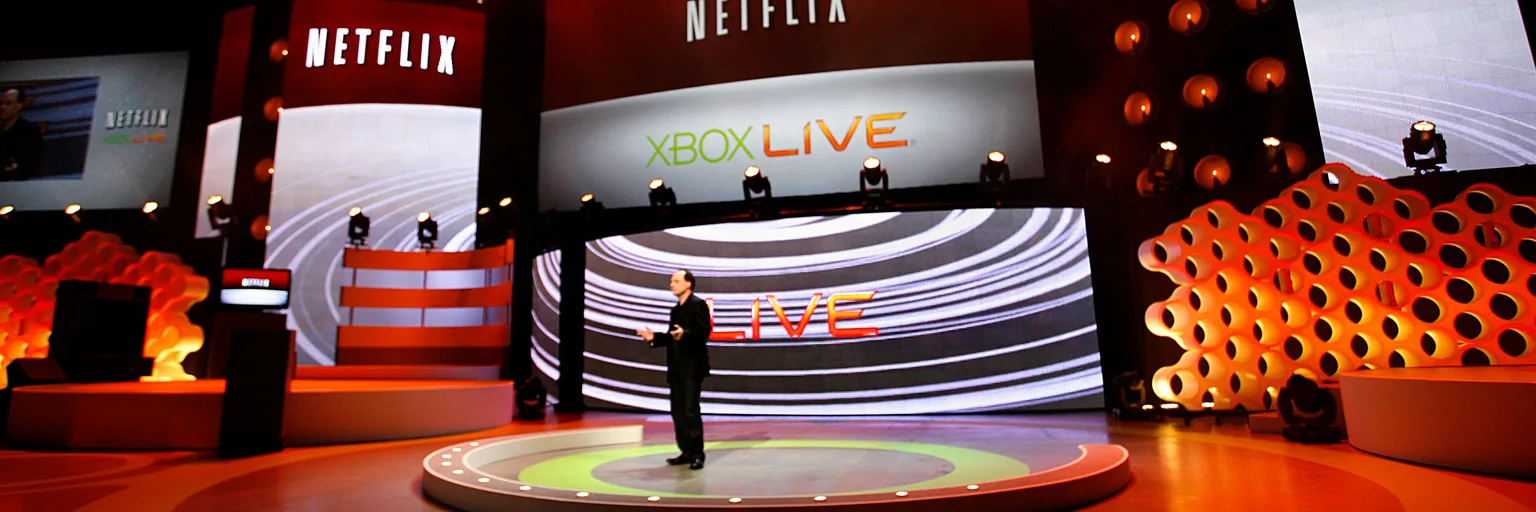
Netflix doesn't have a budget problem: it has a habit problem
Users open the app on fewer days and the average customer watches less. Spending more on programming won't rebuild a habit; better product and curation might.
Photo: Ben Brown / Wikimedia Commons (CC BY-SA 2.0)
What do you do when the world's most valuable entertainment company discovers that its customers are drifting away, not by canceling, but by simply forgetting to show up? If you're Netflix, apparently you open the checkbook. We think that's the wrong reflex.
What the numbers say, and what they don't
According to Bloomberg, as republished by Business Times, citing people familiar with confidential data, customers are opening the app on fewer days per month than a couple of years ago. Netflix tracks this with a metric called qualified play days. The average customer is also watching less. Total time on the app rose by a couple of percentage points in the first half of 2026, but only because more customers were added.
Nobody is fleeing. Antenna puts US churn at a steady 2 percent, the best in the industry. Netflix has responded by raising its programming budget and expanding into podcasts and live sports. It also fired its chief content officer, Bela Bajaria, and film chief Dan Lin, and cut 6 percent of staff.
Money buys titles, not routines
Netflix's own executives list several suspects: a new interface, more competition, weaker programming and little marketing outside the service. Reuters reports that analysts also point to the 2026 FIFA World Cup and a weaker content slate than last year. A bigger check can plausibly help with that last one, but in our view it does little for most of the rest. The decline reportedly began after the 2022 password-sharing crackdown, and executives assumed it would be temporary. Instead it has lasted. That reads to us like a structural problem, not just a bad slate.
Habit is the product here. A subscription with best-in-class retention that people open less and less is in danger of turning into a utility you pay for and ignore. The same Bloomberg report notes that the company has struggled to get viewers to watch second and third seasons of existing titles. That looks like a retention problem inside the catalog, and no number of new premieres solves it. More volume can even make it worse, we suspect: a bigger pile of content makes it harder to find the next thing you want to watch.
There is a competitive angle too. The report says Netflix's share of US TV viewing has stagnated as people flock to free services like YouTube. You don't beat a free, endless feed of videos by commissioning more scripted drama. You beat it by making the first 30 seconds in your app feel effortless and personal.
The fix is in the interface and the curation
If the new interface is on the suspect list, Netflix should treat that as the primary lead, not a footnote. Our view, and it is only that, is that the company should spend the next year on three unglamorous things: making continuing a series the easiest action in the app, giving later seasons real promotion, and doing marketing that reaches people before they open the app. A launch that nobody outside the service hears about is a wasted launch.
Co-CEO Ted Sarandos told analysts that US viewership is "just not growing as fast as it could or as fast as we'd like". At a town hall with employees, co-CEO Greg Peters said: "Two things can be true." He's right. The business is profitable and growing, and it is also leaking attention. Investors aren't convinced, with shares down about 29 percent in 2026 so far.
The leadership shake-up is the most interesting signal. Peter Rice, a veteran of Walt Disney and 21st Century Fox, now leads content strategy. We'd wager that's a bet on better programming judgment, not on a bigger spend. That's encouraging, as long as the product team is given the same urgency.
Our verdict
Netflix's budget increase is a sensible hedge, but it answers the wrong question. The company doesn't need people to find more shows. It needs them to remember, on a Tuesday night, that opening Netflix is the obvious thing to do. Until engagement is measured and fixed as a product issue, the stable churn number is, in our view, a comfortable illusion. Habits fade slowly, and then cancellations may not.
No topics yet: start the first one.
More stories
Percy Jackson on Netflix isn't a leak: it's Disney's smartest trick
Percy Jackson's Netflix surge looks like Disney feeding a rival, but a timed loan before Season 3 is a strategy, and it only works if Disney keeps it deliberate.

The Invite proves adult comedy never died: it just needs a second life
Olivia Wilde's dramedy went from Sundance to a theatrical hit to HBO Max, and the lesson for studios is about sequencing, not survival.

Fallout as reality TV is risky, but it may be Prime Video's smartest play
Turning Vault-Tec's cruelty into a $1,000,000 game show sounds like self-parody, but with the right producers and tone it could keep Fallout alive between seasons.

Netflix blinked on Xbox, and that's the smartest thing it did all year
A reported $500 million offer met an $800 million ask. Netflix pulling out suggests Xbox IP is priced like prestige gold, and that streamers shouldn't overpay for adaptations.